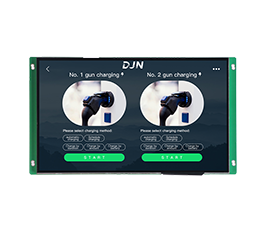
A suitable sunlight readable LCD display for EV chargers needs to maintain clear visibility under direct sunlight while balancing brightness, thermal performance, power consumption, and long-term reliability. Outdoor charging stations typically face strong ambient light, temperature fluctuations, weather exposure, and frequent user interaction, making display selection more complex than choosing a standard industrial LCD.
For EV charging equipment, engineers usually evaluate several factors together: display brightness, optical structure, touch performance, environmental durability, and integration requirements. A properly designed sunlight readable display ensures that drivers can easily check charging status, payment information, operating instructions, and error messages even in outdoor conditions.
A sunlight readable LCD display improves outdoor visibility by increasing the amount of light that reaches the user's eyes and reducing the impact of reflected ambient light. Unlike standard indoor displays, outdoor EV charger screens must overcome direct sunlight, glare, and changing viewing conditions.
The most important factors affecting sunlight readability include brightness, contrast ratio, optical design, and display technology.
Brightness is one of the first specifications engineers consider. A conventional indoor LCD may provide sufficient visibility at several hundred nits, but outdoor EV chargers usually require a high-brightness LCD display with significantly higher luminance to maintain readability in bright environments.
The required brightness depends on installation location:
Outdoor charging stations exposed to direct sunlight require higher brightness levels.
Semi-outdoor installations, such as parking garages with strong lighting, may require moderate brightness optimization.
Covered charging areas can use lower brightness displays with improved optical design.
Brightness alone does not determine visibility. A display with high luminance but poor contrast may still appear washed out under sunlight.
An IPS TFT LCD is commonly selected for EV charger applications because it provides wide viewing angles and stable image quality. This is especially useful when drivers approach the charging station from different directions and need to quickly read information from various positions.
Increasing brightness improves outdoor readability, but it also increases power consumption and generates additional heat. For EV chargers operating continuously in outdoor environments, thermal management becomes an important part of display design.
A high-brightness TFT display requires careful engineering to balance visibility and system efficiency. Excessive backlight power can increase internal temperature, potentially affecting display lifetime and surrounding electronic components.
Modern industrial displays often use optimized LED backlight systems to achieve high brightness while maintaining reasonable power consumption. Engineers may consider:
High-efficiency LED backlight design.
Automatic brightness adjustment according to ambient light conditions.
Thermal solutions based on enclosure structure and installation environment.
EV chargers are often installed in locations exposed to summer heat, winter cold, and long operating hours. The selected LCD module should support the expected operating temperature range and maintain stable brightness performance over time.
For outdoor charging equipment, display reliability depends not only on the panel itself but also on the complete thermal design of the display assembly.
The front structure of an EV charger display has a major influence on sunlight readability. A high-performance LCD module can still experience poor visibility if the cover glass, air gap, or touch layer creates excessive reflection.
Optical bonding reduces the air gap between the LCD panel, touch sensor, and cover glass by filling it with optical adhesive. This structure helps reduce internal reflections and improves contrast under strong lighting conditions.
For outdoor EV charging stations, optical bonding can provide several benefits:
Reduced glare caused by reflected sunlight.
Improved image clarity and contrast.
Better resistance against dust and moisture entering between layers.
Enhanced mechanical durability.
Many EV chargers use touchscreen interfaces instead of physical buttons. Integrating a capacitive touch panel allows users to interact with charging settings, payment systems, and operational menus more efficiently.
However, touch integration requires careful matching between the LCD module, touch sensor, cover glass thickness, and controller performance. Outdoor applications must also consider glove operation, water resistance, and touch sensitivity under different weather conditions.
The cover glass should provide protection while maintaining optical performance. Factors such as thickness, anti-glare coating, anti-reflective treatment, and durability requirements should be evaluated according to the charging environment.
Selecting a display for EV chargers requires validation beyond basic specifications. An experienced ODM display manufacturer evaluates the complete module design to ensure reliable performance in real outdoor applications.
Key validation areas include:
Sunlight visibility testing: Confirming readability under different outdoor lighting conditions.
Temperature testing: Verifying display operation during high and low temperature cycles.
Touch performance testing: Ensuring stable operation with gloves, moisture, and repeated usage.
Mechanical testing: Checking resistance to vibration, impact, and long-term outdoor exposure.
ODM customization can also adapt the display according to EV charger requirements, including screen size, brightness level, interface type, touch solution, and mechanical structure.
At DJN LCD, we provide customized IPS TFT LCD solutions for industrial and outdoor applications. Our engineering team supports display selection and optimization based on brightness requirements, environmental conditions, and HMI integration needs for EV charging equipment.
A sunlight readable LCD display is designed to maintain clear visibility in bright outdoor environments by combining high brightness, optimized contrast, and optical improvements such as anti-glare or optical bonding technologies.
The required brightness depends on installation conditions, sunlight exposure, and display structure. Outdoor EV chargers commonly require higher brightness levels than indoor equipment, especially when installed in direct sunlight.
Yes. IPS TFT LCD technology is widely used in industrial applications because it provides wide viewing angles, stable colors, and reliable image performance for users approaching the charger from different directions.
Optical bonding reduces reflections between display layers by eliminating the air gap between the LCD, touch panel, and cover glass. This improves contrast and makes the screen easier to read under strong sunlight.
Yes. A capacitive touch panel can be integrated into EV charger displays, but the touch solution should be designed for outdoor conditions, including moisture resistance, glove operation, and environmental durability.
Engineers should evaluate brightness, contrast, viewing angle, temperature range, power consumption, touch integration, optical structure, and long-term reliability to select a suitable display solution.
Choosing a display for EV chargers requires evaluating the entire display system rather than focusing only on brightness specifications. A reliable outdoor solution combines a high brightness LCD display, suitable TFT technology, optical optimization, touch integration, and environmental protection.
By selecting the right sunlight readable display and working with an experienced display partner, EV charger manufacturers can achieve better visibility, improved user experience, and long-term product reliability in demanding outdoor environments.



 English
  中文
中文  日本語
日本語  한국어
한국어  français
  Deutsch
  Español
  italiano
  русский
  Türkçe
  português
  Indonesia